I came home from an outing with T. on Wednesday to discover our bento boxes had arrived! I'd spent the week before convincing Scott that bento boxes were going to change our lives--or, at least, help us help L. change his school lunch habits (which mainly include sitting in his seat at the cafeteria and leaving his lunchbox unopened on the table in front of him).
T. was very excited to get her box. It's pink, of course.

 She was so excited I had to wash it right away and fix her lunch in it. The only snag is that the bento boxes don't fit into the kids' conventional lunch boxes, so we had to find some type of bag for them to use. For .79 cents at Whole Foods I bought two of these...
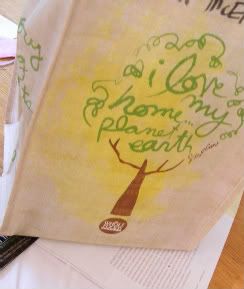 I have one of these in the large size for groceries. These small ones are about the size of a gift bag.
...wrote the kids' names on the top front in permanent marker, and they are perfect. They not only fit the bento boxes, but the kids' metal water bottles. I can also tuck a thermos into the bag in the winter if I pack soup or warm food for T.
I approached the bento box business carefully with L. We've learned, through much trial and error, that how we present something to L. can make or break his response to it. I showed him the handy Laptop Lunch User's Guide that came with the box, and we read through some of the information (did you know, for instance, that on average a school-child using a disposable lunch generates 67 pounds of waste per school year?). We are coupling the new lunch system with a reward chart for L.--more on that next week (I'm still tweaking it).
So far, he seems excited, and in the car on the way to school yesterday he almost caused me to swerve into a tree when he said, casually from the back seat, "you know Mama, with this new bento box I'm almost looking forward to lunch in the cafeteria."
************
In my quest to find a variety of healthy, packable items for L.'s lunch (and for T.'s when the time comes) I've been buying some bulk "energy squares" from Whole Foods. The kids love them, but they're on the expensive side for a bulk item. I've been searching for a recipe that would fit the concept--a dry, nutty, crunchy, packable square. When the bento boxes arrived I was delighted to flip through the user's guide and find an easy and nutritious recipe for "Oatmeal Bars"--very much like Nature Valley's granola bars, only softer. I adapted it a bit, and whipped up a batch in no time at all. Both my kids love oatmeal, wet or dry.
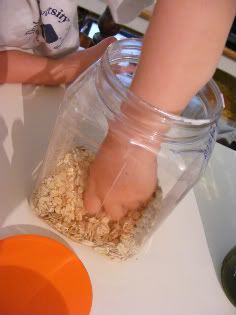
This is T. with her hand caught in the oatmeal jar:
I have one of these in the large size for groceries. These small ones are about the size of a gift bag.
...wrote the kids' names on the top front in permanent marker, and they are perfect. They not only fit the bento boxes, but the kids' metal water bottles. I can also tuck a thermos into the bag in the winter if I pack soup or warm food for T.
I approached the bento box business carefully with L. We've learned, through much trial and error, that how we present something to L. can make or break his response to it. I showed him the handy Laptop Lunch User's Guide that came with the box, and we read through some of the information (did you know, for instance, that on average a school-child using a disposable lunch generates 67 pounds of waste per school year?). We are coupling the new lunch system with a reward chart for L.--more on that next week (I'm still tweaking it).
So far, he seems excited, and in the car on the way to school yesterday he almost caused me to swerve into a tree when he said, casually from the back seat, "you know Mama, with this new bento box I'm almost looking forward to lunch in the cafeteria."
************
In my quest to find a variety of healthy, packable items for L.'s lunch (and for T.'s when the time comes) I've been buying some bulk "energy squares" from Whole Foods. The kids love them, but they're on the expensive side for a bulk item. I've been searching for a recipe that would fit the concept--a dry, nutty, crunchy, packable square. When the bento boxes arrived I was delighted to flip through the user's guide and find an easy and nutritious recipe for "Oatmeal Bars"--very much like Nature Valley's granola bars, only softer. I adapted it a bit, and whipped up a batch in no time at all. Both my kids love oatmeal, wet or dry.
This is T. with her hand caught in the oatmeal jar:
 Lunchbox Oatmeal Bars (adapted from the Laptop Lunchbox recipe)
3 cups whole oats
2/3 cup whole wheat flour
1/2 teaspoon baking soda
1/2 teaspoon salt
1 teaspoon ground cinnamon
1/3-1/2 cup honey (I added closer to 1/2)
1/3 cup walnut oil (I'm sure you can use canola, too)
1 egg, beaten
1 tablespoon flax seed
4 tablespoons vanilla soy milk1 teaspoon vanilla or almond extract
**I also added 1/2 cup chocolate chips and 1/2 cup raisins. I bet you could add all sorts of things--chopped nuts, dried fruit, peanut butter. I'm planning on experimenting more with the next batch.
Combine oatmeal, flour, flax seed, baking soda, salt, and cinnamon together, and mix well.
In a separate bowl, combine the honey, oil, egg, soy milk, and extract. Mix thoroughly.
Combine wet and dry ingredients together. Fold in any additional ingredients (I added the raisins and chips here).
Using a spatula, press mixture firmly into a lightly oiled cookie sheet. I sprayed mine with canola oil. The mixture won't take up the whole sheet, don't worry.
Lunchbox Oatmeal Bars (adapted from the Laptop Lunchbox recipe)
3 cups whole oats
2/3 cup whole wheat flour
1/2 teaspoon baking soda
1/2 teaspoon salt
1 teaspoon ground cinnamon
1/3-1/2 cup honey (I added closer to 1/2)
1/3 cup walnut oil (I'm sure you can use canola, too)
1 egg, beaten
1 tablespoon flax seed
4 tablespoons vanilla soy milk1 teaspoon vanilla or almond extract
**I also added 1/2 cup chocolate chips and 1/2 cup raisins. I bet you could add all sorts of things--chopped nuts, dried fruit, peanut butter. I'm planning on experimenting more with the next batch.
Combine oatmeal, flour, flax seed, baking soda, salt, and cinnamon together, and mix well.
In a separate bowl, combine the honey, oil, egg, soy milk, and extract. Mix thoroughly.
Combine wet and dry ingredients together. Fold in any additional ingredients (I added the raisins and chips here).
Using a spatula, press mixture firmly into a lightly oiled cookie sheet. I sprayed mine with canola oil. The mixture won't take up the whole sheet, don't worry.
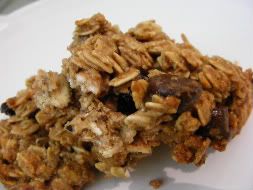
 Bake at 350 for 12-15 minutes, or until lightly browned and firm to the touch. Remove from oven and cool. Using a knife, cut into small rectangles.
 I'll let you know next week how L. did with his school lunch on Day 1 of Operation Bento Box--until then, Happy Weekend!
She was so excited I had to wash it right away and fix her lunch in it. The only snag is that the bento boxes don't fit into the kids' conventional lunch boxes, so we had to find some type of bag for them to use. For .79 cents at Whole Foods I bought two of these...
I have one of these in the large size for groceries. These small ones are about the size of a gift bag.
...wrote the kids' names on the top front in permanent marker, and they are perfect. They not only fit the bento boxes, but the kids' metal water bottles. I can also tuck a thermos into the bag in the winter if I pack soup or warm food for T.
I approached the bento box business carefully with L. We've learned, through much trial and error, that how we present something to L. can make or break his response to it. I showed him the handy Laptop Lunch User's Guide that came with the box, and we read through some of the information (did you know, for instance, that on average a school-child using a disposable lunch generates 67 pounds of waste per school year?). We are coupling the new lunch system with a reward chart for L.--more on that next week (I'm still tweaking it).
So far, he seems excited, and in the car on the way to school yesterday he almost caused me to swerve into a tree when he said, casually from the back seat, "you know Mama, with this new bento box I'm almost looking forward to lunch in the cafeteria."
************
In my quest to find a variety of healthy, packable items for L.'s lunch (and for T.'s when the time comes) I've been buying some bulk "energy squares" from Whole Foods. The kids love them, but they're on the expensive side for a bulk item. I've been searching for a recipe that would fit the concept--a dry, nutty, crunchy, packable square. When the bento boxes arrived I was delighted to flip through the user's guide and find an easy and nutritious recipe for "Oatmeal Bars"--very much like Nature Valley's granola bars, only softer. I adapted it a bit, and whipped up a batch in no time at all. Both my kids love oatmeal, wet or dry.
This is T. with her hand caught in the oatmeal jar:
Lunchbox Oatmeal Bars (adapted from the Laptop Lunchbox recipe)
3 cups whole oats
2/3 cup whole wheat flour
1/2 teaspoon baking soda
1/2 teaspoon salt
1 teaspoon ground cinnamon
1/3-1/2 cup honey (I added closer to 1/2)
1/3 cup walnut oil (I'm sure you can use canola, too)
1 egg, beaten
1 tablespoon flax seed
4 tablespoons vanilla soy milk1 teaspoon vanilla or almond extract
**I also added 1/2 cup chocolate chips and 1/2 cup raisins. I bet you could add all sorts of things--chopped nuts, dried fruit, peanut butter. I'm planning on experimenting more with the next batch.
Combine oatmeal, flour, flax seed, baking soda, salt, and cinnamon together, and mix well.
In a separate bowl, combine the honey, oil, egg, soy milk, and extract. Mix thoroughly.
Combine wet and dry ingredients together. Fold in any additional ingredients (I added the raisins and chips here).
Using a spatula, press mixture firmly into a lightly oiled cookie sheet. I sprayed mine with canola oil. The mixture won't take up the whole sheet, don't worry.
Bake at 350 for 12-15 minutes, or until lightly browned and firm to the touch. Remove from oven and cool. Using a knife, cut into small rectangles.
I'll let you know next week how L. did with his school lunch on Day 1 of Operation Bento Box--until then, Happy Weekend!